
- Home
- About
- Map
- Trips
- Bringing Boat West
- Migration West
- Solo Motorcycle Ride
- Final Family XC Trip
- Colorado Rockies
- Graduates' XC Trip
- Yosemite & Nevada
- Colorado & Utah
- Best of Utah
- Southern Loop
- Pacific Northwest
- Northern Loop
- Los Angeles to NYC
- East Coast Trips
- Martha's Vineyard
- 1 Week in Quebec
- Southeast Coast
- NH Backpacking
- Martha's Vineyard
- Canadian Maritimes
- Ocracoke Island
- Edisto Island
- First Landing '02
- Hunting Island '02
- Stowe in Winter
- Hunting Island '01
- Lake Placid
- Chesapeake
- Provincetown
- Hunting Island '00
- Acadia in Winter
- Boston Suburbs
- Niagara Falls
- First Landing '99
- Cape Hatteras
- West Coast Trips
- Carmel
- Burning Man
- Utah Off-Roading
- Maui
- Mojave 4WD Course
- Colorado River Rafting
- Bishop & Death Valley
- Kauai
- Yosemite Fall
- Utah Off-Road
- Lost Coast
- Yosemite Valley
- Arizona and New Mexico
- Pescadero & Capitola
- Bishop & Death Valley
- San Diego, Anza Borrego, Joshua Tree
- Carmel
- Death Valley in Fall
- Yosemite in the Fall
- Pacific Northwest
- Utah Off-Roading
- Southern CA Deserts
- Yosemite & Covid
- Lake Powell Covid
- Eastern Sierra & Covid
- Bishop & Death Valley
- Central & SE Oregon
- Mojave Road
- Eastern Sierra
- Trinity Alps
- Tuolumne Meadows
- Lake Powell Boating
- Eastern Sierra
- Yosemite Winter
- Hawaii
- 4WD Eastern Sierra
- 4WD Death Valley +
- Southern CA Deserts
- Christmas in Tahoe
- Yosemite & Pinnacles
- Totality
- Yosemite & Sierra
- Yosemite Christmas
- Yosemite, San Diego
- Yosemite & North CA
- Seattle to Sierra
- Southwest Deserts
- Yosemite & Sierra
- Pacific Northwest
- Yosemite & South CA
- Pacific Northwest
- Northern California
- Southern Alaska
- Vancouver Island
- International Trips
- Index
- Tips
- Books
- Photos/Videos
- Search
- Contact
Opoutere Beach, New Zealand
Saturday, December 6, 2025 - 10:00pm by Lolo
194 miles and 4.25 hours from our last stop - 1 night stay
Travelogue
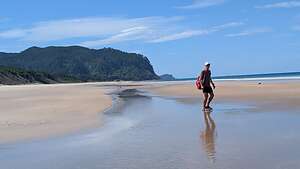 Opoutere BeachToday we would say goodbye to the amazing geothermal wonders of the Taupo Volcanic Zone and head north to the Coromandel Peninsula to experience some of the North Island’s beautiful white sand beaches.
Our first destination was Opoutere Beach, one of the Coromandel Peninsula’s hidden gems, known for its remote, untouched beauty and 3 miles of pristine white sand.
Our plan was to stay one or two nights at the Opoutere Coastal Campground and then move further north to the Hahei Beach Resort in the Cathedral Cove area of Coromandel.
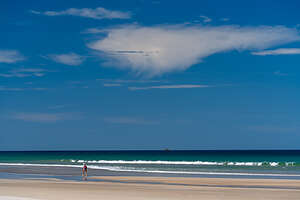 Opoutere BeachThe campground was rustic, but we were quite self-contained in our campervan. It was actually quite relaxing and peaceful, set in a forest which separated us from the beach.
After settling in, which basically means parking our camper on our site, we set out through the pine forest to see the beach.
We were a little taken aback at the signs that said “Danger, poison Pine Trees may fall at any time.” Well that was a little disconcerting. I had never heard of such a thing.
I later learned that these pines are an invasive species that outcompete native trees like pōhutukawa, kōwhai, and māhoe from growing, so the Department of Conservation is trying to eliminate them by poisoning them.
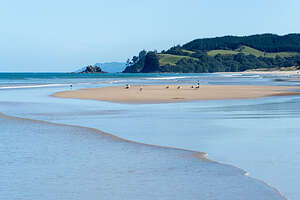 Ohui InletThey do this by drilling small holes in their trunk and then injecting a herbicide into their vascular system. This causes the trees to die standing up.
The DOC monitors them, and when they become a “fall hazard,” they are cut down. The warning was so that we, and other unsuspecting beach goers, wouldn’t touch them and also keep an eye out to avoid falling branches.
.
Thousands of native seedlings were planted beneath the dying trees in the hope that someday it would transition back to a forest of native trees and shrubs.
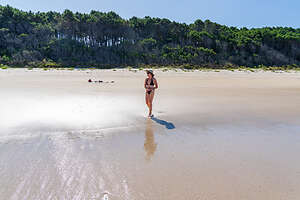 Opoutere Beach StrollOkay, that was unexpected danger number one. Danger number two was waiting for us out on the beach and was a bit more Hitchcockesque. Think “The Birds.”
Opoutere Beach is a breeding ground for two endangered species, the New Zealand Dotterel, and the Oystercatcher, who is only endangered because they put their nests, which are just small hollows in the sand, right in the path of people strolling on the beach.
While this might seem stupid, there actually is a fairly calculated survival strategy to this. If they put their nests too close to the water they could get washed away by a king tide. If they put them back against the forest, the babies could more easily get eaten by predators. Putting them in the middle between on the dry sand above the high tide line, but away from the forest, isn’t perfect because that is where humans like to walk and set up their beach chairs.
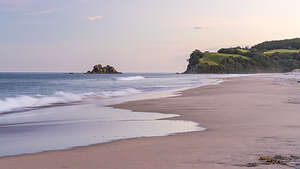 Sunset strollApparently for the oystercatchers, option 3, is the least of the 3 dangers, both because predators stay away from humans, and secondly, oblivious beach walkers are easily frightened away by their rather effective divebombing, which we soon learned.
So, as we strolled along this lovely pristine beach, we were totally oblivious to the fact that an oystercatcher was staring us down and taking tiny steps towards us. Soon those tiny steps picked up speed, before taking flight and divebombing our heads.
Herb and I took two different approaches to dealing with this unexpected situation. Herb took off his hat and started swatting the bird away. I took the less dignified approach and screamed and did a tuck and roll onto the sand, while putting my hands over my head. My only regret is that Herb was doing busy swatting them to take a photo of this bizarre scene.
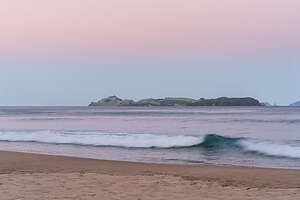 Sunset strollHerb was quite amused and told me I should just swat them away.
Not wanting to let these birds spoil our beach stroll, we forged on. After two more divebombing experiences, I suggested we return to the campsite for a glass of wine, with my promise to return at sunset, but only with a swatting implement.
So, back we went through the poison forest (this was beginning to feel like a bad fairy tale) to our campsite where little children were delightfully playing, unaware of the evils that lurked beyond.
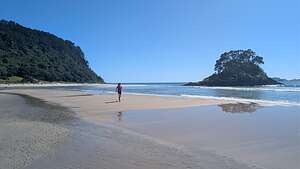 Morning run to Ohui InletWe did return through the forest to the beach to watch the sunset, where the sky and waves turned a lovely pastel pink and blue. We stuck to the northern end of the beach where the oystercatchers didn’t nest.
The next morning, we decided to not let the oystercatchers control our lives and go for a run along the beach. I think we knew a little more now as to how to deal with them.
Glad we did, because it was a great run, all the way to the Ohui Inlet at the northern end of the beach. 5.5 miles in sometimes deep wet sand was a really good workout.
Although we had another night booked in this campsite, we decided we pretty much had seen it all and decided to move north to the Hahei Beach Resort which I had booked for three nights..
- ‹ previous
- 6 of 10
- next ›
Opoutere Beach location map in "high definition"
Javascript is required to view this map.