- Home
- About
- Map
- Trips
- Bringing Boat West
- Migration West
- Solo Motorcycle Ride
- Final Family XC Trip
- Colorado Rockies
- Graduates' XC Trip
- Yosemite & Nevada
- Colorado & Utah
- Best of Utah
- Southern Loop
- Pacific Northwest
- Northern Loop
- Los Angeles to NYC
- East Coast Trips
- Martha's Vineyard
- 1 Week in Quebec
- Southeast Coast
- NH Backpacking
- Martha's Vineyard
- Canadian Maritimes
- Ocracoke Island
- Edisto Island
- First Landing '02
- Hunting Island '02
- Stowe in Winter
- Hunting Island '01
- Lake Placid
- Chesapeake
- Provincetown
- Hunting Island '00
- Acadia in Winter
- Boston Suburbs
- Niagara Falls
- First Landing '99
- Cape Hatteras
- West Coast Trips
- Carmel
- Burning Man
- Utah Off-Roading
- Maui
- Mojave 4WD Course
- Colorado River Rafting
- Bishop & Death Valley
- Kauai
- Yosemite Fall
- Utah Off-Road
- Lost Coast
- Yosemite Valley
- Arizona and New Mexico
- Pescadero & Capitola
- Bishop & Death Valley
- San Diego, Anza Borrego, Joshua Tree
- Carmel
- Death Valley in Fall
- Yosemite in the Fall
- Pacific Northwest
- Utah Off-Roading
- Southern CA Deserts
- Yosemite & Covid
- Lake Powell Covid
- Eastern Sierra & Covid
- Bishop & Death Valley
- Central & SE Oregon
- Mojave Road
- Eastern Sierra
- Trinity Alps
- Tuolumne Meadows
- Lake Powell Boating
- Eastern Sierra
- Yosemite Winter
- Hawaii
- 4WD Eastern Sierra
- 4WD Death Valley +
- Southern CA Deserts
- Christmas in Tahoe
- Yosemite & Pinnacles
- Totality
- Yosemite & Sierra
- Yosemite Christmas
- Yosemite, San Diego
- Yosemite & North CA
- Seattle to Sierra
- Southwest Deserts
- Yosemite & Sierra
- Pacific Northwest
- Yosemite & South CA
- Pacific Northwest
- Northern California
- Southern Alaska
- Vancouver Island
- International Trips
- Index
- Tips
- Books
- Photos/Videos
- Search
- Contact
Indiana Dunes National Lakeshore
Wednesday, August 2, 2000 - 1:00pm by Lolo244 miles and 4.5 hours from our last stop - 2 night stay
Travelogue
I had found out about Indiana Dunes in the National Geographic State Park book which highlights the best state parks in each state. Besides being a state park, there is also about 15 miles of National Lakeshore adjacent to it, so I expected it to be pretty good.
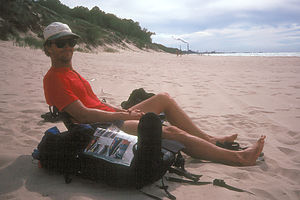 Herb with SmokestackI admit that I was a bit disappointed. Although the dunes were impressive and fun to roll around on, it wasn't nearly as pristine as I expected. I had hoped for another experience like Sleeping Bear Dunes, but this was not even close. The park was positioned between Gary and Michigan City, both pretty industrial-type towns. Their smokestacks, spewing god knows what, were quite visible as you gazed down the beach. As if that wasn't bad enough, swimming in Lake Michigan was prohibited because of high e.coli counts.
Since swimming was out of the question, we took a nice long hike along the dunes and a bike ride along the Calumet Bike Trail, which runs along a railroad bed through some pretty nice sand dunes, forests, and marshes. The kids' favorite activity by far was climbing and rolling back down the Devil's Slide, a steep dune overlooking the beach pavilion. Being the competitive family we are, we had races up the dune. Running in sand up a hill is unbelievably exhausting.
This was it, the end of our trip. The next day we would make the 13-hour push for home.
Description
Indiana Dunes National Lakeshore, which stretches about 15 miles along the southern shoreline of Lake Michigan between Gary and Michigan City, has some of the highest dunes along the Lake Michigan shore. These dunes are called "living" dunes because they continue to move inland a few feet each year, burying plants and trees as they go.
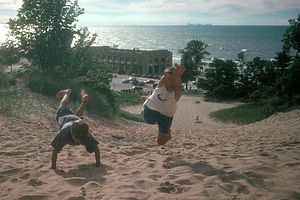 Kid's dune jumpingWithin the National Lakeshore, a 3-mile section of the beach is actually a very popular State Park. This is where most of the action and facilities at Indiana Dunes are located. There is a large beach pavilion complete with snack bar and gift shop, a nature center, a lifeguard protected swimming beach, over 16 miles of dune hiking trails, and a large 286-site campground.
Another popular trail is the 9.2-mile Calumet Bike Trail, which is located in the National Lakeshore section of the Dunes about 2 miles inland. This trail runs along a railroad bed through a wide variety of habitats--beach, sand dunes, black oak forest, and marshes.
Herbert Hoover National Historic Site
Wednesday, August 2, 2000 - 9:00am by Lolo253 miles and 4.5 hours from our last stop
Travelogue
We were into that phase of the trip--long driving days home across the plains with little in the way of family entertainment. That's why even my suggestion of stopping at the Herbert Hoover National Historic Site was greeted with such enthusiasm. It's all in the timing.
"Maybe they sell hat pins," Andrew said hopefully always anxious to add to his already impressive collection. Wanting to discourage this "hat pin bagging" mentality, we explained that pins should not be goals in themselves, but rather a souvenir of memorable experience. I'm sure that made a big impression.
Although we joke about the Herbert Hoover Historical Site being our trip highlight, it was actually quite enjoyable and educational. Apparently, Hoover was a Quaker, so the site contained a re-created Quaker Village of the type that he grew up in, complete with blacksmith shop, meetinghouse, and schoolhouse. We also got to see the 2-room cottage that he was born in. I don't know why, but there is something about historical villages that makes me happy. The kids thought it was pretty good too.
Description
The Herbert Hoover Historic Site in West Branch, Iowa, is a re-creation of the 1870s Quaker Village that Herbert Hoover grew up in, complete with blacksmith shop, Friends meetinghouse, and a typical Quaker schoolhouse.
The Historic Site also contains the simple two-room cottage that Hoover was born in as well as his gravesite. The Presidential Library-Museum, also on the site, contains many documents and exhibits related to his life in public service.
Hoover's life was shaped by his Quaker upbringing and the strong principles of honesty, hard work, and generosity. Although orphaned when young, he studied hard, worked as a mining engineer, and became a millionaire by the age of 40.
Before he was elected president, he served in many public positions. His Quaker ideals are exemplified in the way he worked tirelessly to help feed the millions of hungry people in countries devastated by World War I.
Herbert Hoover became the 31st president in 1928. One year later, the stock market crashed sending the nation into the Great Depression. Despite Hoover's efforts to improve the country's economic distress, his popularity declined, and he lost the 1932 election to Franklin D. Roosevelt.
Many in the country blamed Hoover for not doing more to bring the nation out of the depression, and he left office more reviled than any other president.
Wilson Island State Park
Tuesday, August 1, 2000 - 10:00am by Lolo240 miles and 4.5 hours from our last stop - 1 night stay
Travelogue
We were now into the long, monotonous driving days home across the plains. As I was scanning the campground guides for a nice place to stop, I couldn't help but notice how close we were to Nebraska, a state we had not yet laid claim to on our RV map. After some mental struggle, I did something that I am ashamed of today--I had Herb get off I29, cross the Missouri River into Nebraska, and drive down the west side of the river before crossing back into Iowa, just so that we could put Nebraska on our map--the infamous "Nebraska dip" as we call it today. I was not proud of what I had done, but I just want it noted that since that time, we have spent several wonderful days at Lake McConaughy in Nebraska, truly earning our claim to having visited the state.
We spent that night at a very nice state park along the banks of the Missouri River in Western Iowa, called Wilson State Park. After spending so much time out west, everything here seemed so lush and green--more like back home. I guess our trip was coming near an end.
The next morning before we left, I went for a very nice run through the De Soto National Wildlife Refuge which was adjacent to the state park. During my run, I noticed that there were tornado sirens positioned throughout the park, poised to squeal at the first signs of any tornadic activity. I guess that's a genuine concern in this area of the country. Thankfully, they were quiet now, but it reinforced the weather phobia I have every time we cross the plains.
Description
Wilson Island State Park is located in western Iowa on the banks of the Missouri River. The park is popular for boating, fishing, and hunting. A half-mile trail along the shoreline of the Missouri River and a boat ramp provide easy access to the river. There are an additional five miles of trails that are good for hiking and mountain biking.
There is a campground with 140 well-shaded, spacious campsites.
Just to the north of the state park is the DeSoto National Wildlife Refuge, which has additional hiking trails and is also good for fishing, hunting, and observing wildlife, such as deer, snow geese and bald eagles.
According to historians, Lewis and Clark camped along this part of the Missouri River on their historic trip to the Pacific Coast back in 1804.
Cabela's
Tuesday, August 1, 2000 - 6:00am by Lolo210 miles and 4 hours from our last stop
Travelogue
If there is one defining characteristic of our family, I would have to say that it is a love of the outdoors and all the wonders it has to offer. Enjoying the outdoors often requires some equipment. As a result, we have a room in our basement affectionately nicknamed Campmor (after a large mail order outdoor outfitter), filled with every conceivable piece of outdoor gear--rock climbing, ice climbing, mountaineering, fishing of every variety, camping, mountain biking, etc., etc. That is why Herb knew that on our drove home on I90, we would be passing a Cabela's in Mitchell, South Dakota. I'm not sure what else we could possibly need, but we decided to stop anyway to break up the long driving day.
Well, apparently we did need something--our poor, deprived sons did not have fly rods. They had caught blues and stripers with their surf rods, bass and trout with their spinning rods, but had not yet had the experience of flailing a fly line and placing a dry fly in front of an unsuspecting trout. They had seen their father's joy in catching a trout with his fly rod in Yellowstone Lake, and now wanted in on the action. At Cabela's they each got a very nice setup for $50, complete with rod, reel, fly line, and case.
Description
Cabela's is the world's foremost outfitter of hunting, fishing, and outdoor gear. It began in 1961 when Dick Cabela ran an ad in a Wyoming newspaper trying to sell hand-tied flies, 12 for $1. From those humble beginnings, Cabela's has grown into an organization with 11 retail stores, a huge mail order and internet business, and 7,000 employees. The founders have kept it a family-owned business and still play a very active role in the organization.
Badlands National Park
Monday, July 31, 2000 - 10:00am by Lolo32 miles and 1 hour from our last stop - 1 night stay
Travelogue
After a very entertaining stop at Wall Drug, we headed for Badlands National Park. Badlands is an easy National Park to visit because it has a 32-mile scenic drive that runs from east to west across the park past several scenic overlooks and trailheads for hikes. Since we were heading home, we entered the park at the Pinnacles Entrance in the western portion of the park.
 Notch Trail Shaky Ladder ClimbThis was the first time since we left Michigan about 2½ weeks ago that we didn't have a reservation for the night. Wow, free spirits at last. When we got our first look at the South Dakota badlands from the Pinnacles Overlook, we knew that we wanted to spend the night here. The view was incredible--sharp, jagged ridges and multicolored buttes rising out of the prairie.
Now began the debate as to where to stay. It was over 100 degrees, so my vote was for the Badlands KOA right outside the park where there was a pool and we could run our air conditioning. After our horrible commercial campground experience at Mt. Rushmore, Herb wanted to stay at the Cedar Pass Campground inside the park. He assured me, and I must admit he was correct, that this was the desert and temperatures dropped significantly at night so we wouldn't need air conditioning. He won. The campground was lovely--great views of the Badlands and a nice shade covering over the picnic table.
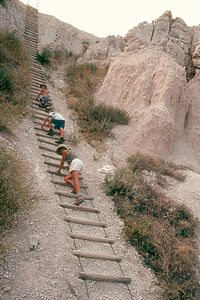
After lunching and enjoying the views at the campsite, we headed to the Visitor Center to get some information on hikes so that we could experience the badlands more intimately. I had chosen the 1.5 mile Notch Trail, but a very acrophobic woman ranger nearly talked us out of it when she described how you had to climb a steep, shaky ladder and then walk along a narrow cliff edge that dropped sharply off into a steep gully. Although this information made me think twice about the hike, it actually intrigued the kids even more. If they were enthused about a hike, I'm there.
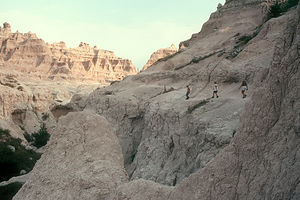 Badlands Notch Trail hikeI'm really glad we didn't listen to her--it wasn't nearly as bad as she made it out to be. There was in fact a steep, shaky ladder, but it was no big deal and although the cliff edge made my palms sweat a little more, it was also very doable. What the kids liked best was that they were able to climb and scamper on the rock formations as they went along--not like other parks were you always had to stay on a trail and just admire the rocks. At the end of the hike we were rewarded with a spectacular view of the badlands and prairie below.
That evening back at the campground, we watched a beautiful sunset from our picnic table. After dinner, the kids and I decided to go to the campground amphitheater for the Ranger Program. I really like to take advantage of these programs--they're always very informative and well done, especially if you have an enthusiastic ranger, which we did. Herb was too content sitting with his Gin and Tonic, gloating about his campground selection, to accompany us so the kids and I went alone, taking along a flashlight to find our way back when it got dark later.
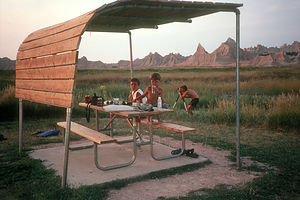 Sunset at the campThe talk was interesting because it focused on life on the Badland's prairie, and made you realize that there was a lot more to this park than just the interesting rock formations. Having very much enjoyed the talk, the kids and I exited the amphitheater into the campground, which now looked totally different in the pitch-black conditions. Despite my ability to navigate our RV across an entire continent, when not equipped with a GPS and laptop I am what Herb politely describes as navigationally impaired. The kids and I proceeded to wander aimlessly up and down each lane in the campground looking for our motor home. Being very aware of my limitations, Herb must have started to get concerned when we didn't return right away. He said he looked out the RV and in the distance he saw 3 little heads wandering aimlessly back and forth across the campground shining our little beacon of light ahead of us. After a good laugh, he came and rescued us.
Before leaving the Badlands for good the next morning we stopped along the scenic drive to hike the Door Trail. This relatively short, but fairly strenuous hike took us through a break in The Wall called "The Door" and into a very rugged, eroded section of the badland that looks more like the surface of the moon than any place on Earth.
Like Theodore Roosevelt National Park, Badlands was an unexpected highlight for us. The rugged beauty and remoteness of the badlands was something that all four of us had come to love.
Description
Badlands National Park encompasses more than 381 square miles of the eroded buttes, pinnacles, jagged ridges, and prairies that make up the badlands of South Dakota. The rock formations rise from the plains like a city skyline, creating a 100-mile-long natural barrier referred to as The Wall. In fact, early French-Canadian fur trappers named this area les mauvaises terres a traverser or "bad lands to travel across."
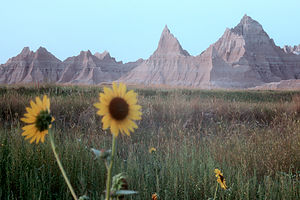 Badlands sunsetThis barren yet beautiful landscape began forming more than 70 million years ago when the climate here was much warmer and wetter, and the Great Plains were covered by a shallow, inland sea. Over time, the land was pushed up, the sea receded, and the black mud of the sea floor hardened into shale, preserving the fossils of animals now long extinct. The area became a flood plain, receiving sediment deposits every time the rivers overflowed. Some of the sediment was mixed with volcanic ash, which together formed clay stone, the main material that makes up the Badlands buttes. Around half a million years ago, wind and water began cutting through the softer layers of sedimentary rock, carving buttes, gullies, and sawtoothed ridges out of the flat flood plains.
The result is the eerie moonscape you see today--jagged sawtoothed ridges and oddly-shaped spires, with their exposed ancient rock layers painted in shades of sand, gold, pink, and red. The erosion has also exposed the rich fossil beds from the ancient sea floor, drawing scientists from around the world to study the preserved remains of extinct animals, such as miniature camels and saber-toothed cats.
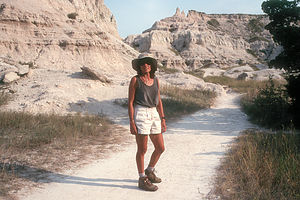 Lolo of the BadlandsThis erosion still continues today, with wind and water washing away an average of one inch of sediment from the buttes each year. At this rate, they will be completely gone in another half a million years.
An excellent way to see the beauty of the Badlands is to drive along the 32-mile Badlands Loop Road that crosses the North Unit of the park, stopping at the numerous scenic overlooks along the way. However, to truly experience the badlands, you have to get out of your car and take one of the hikes into The Wall. There are three excellent hikes that start from the Windows Overlook parking lot.
The ¾ mile, fairly strenuous Door Trail passes through a break in The Wall called "The Door" into a very rugged, eroded section of the badland that looks more like the surface of the moon than any place on Earth.
The ¼ mile easy Window Trail leads to a spectacular view of a deeply eroded canyon through an opening called "The Window."
The 1½ mile, fairly strenuous Notch Trail is not recommended for those with a fear of heights, as it requires you to climb a steep, shaky ladder and then climb along the side of a steep gully to a break in the wall called "The Notch" where there is a commanding view of the Cliff Shelf area and the White River Valley below.
Wall Drug
Monday, July 31, 2000 - 4:00am by Lolo80 miles and 1.5 hours from our last stop
Travelogue
The kids, especially Tommy, love to shop, so when we told them about Wall Drug they were pretty worked up. We didn't have any choice but to tell them. It's impossible to sneak through South Dakota without seeing the hundreds of signs lining the highway, counting down the mileage to Wall Drug and trying to lure you in with the promise of free ice water--pretty good marketing ploy. The Husteads started it back in 1931 in an attempt to get cars to come off the highway and shop in their drug store. It worked. Today it's the largest drug store in the world.
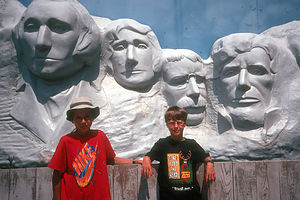 Kids at Wall Drug 'Mount Rushmore'You could buy everything there. They had camping supplies, jewelry, cowboy clothes, rattlesnake ashtrays, tacky souvenirs, and thankfully, hat pins to add to our collection. Even better than all the nosh they were selling, were the free attractions. There was a life-sized Cowboy Orchestra that played every 15 minutes, a shooting gallery, a miniaturized version of Mt. Rushmore, and my personal animated favorite--a giant 30-foot Tyrannosaurus Rex that scared the you-know-what out of us every 15 minutes even though we knew it was coming.
The whole Wall Drug experience was unbelievable. With all the natural wonders we were seeing, it was good to throw in a little culture once in awhile.
Description
Anyone that has traveled across South Dakota on I90 is sure to have seen the hundreds of signs advertising free ice water at Wall Drug. The story of what has now become one of South Dakota's main visitor attractions began in 1931 when Dorothy and Ted Hustead purchased the only drugstore in the small town of Wall, at the edge of the South Dakota Badlands. After 5 years of tough times during the Depression, Dorothy had an idea to get people to stop in their store: put up signs on the highway advertising free ice water. That simple concept, combined with great service and good prices, has helped the Hustead's grow their business into the world's largest drug store.
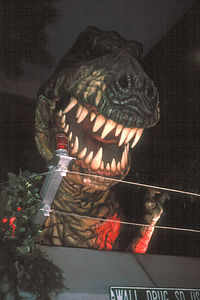 Wall Drug T-RexToday the store is a giant block-long emporium which draws more than 20,000 visitors a day in the summer. Besides being a store selling everything from Western wear to camping supplies to Indian jewelry, it is also a museum displaying thousands of historical photographs and memorabilia of its history and the region's. Even more of a draw are the free attractions, such as the life-size animated Chuck Wagon Quartet, the 30 foot high animated T-Rex that comes to life every 15 minutes, a replica of Mt. Rushmore, a shooting gallery arcade, and much more. There's even a dining room serving great country food that seats over 500 people.
Today the signs telling how many miles to Wall Drug not only extend for hundreds of miles along I90 in South Dakota, but they are found in numerous places around the world, including the North Pole, India, Kenya, Paris, etc. Some of these signs were put there by Wall Drug but many others by happy customers just wanting to spread the word.
Mount Rushmore
Sunday, July 30, 2000 - 2:00pm by Lolo47 miles and 1 hour from our last stop - 1 night stay
Travelogue
Before visiting the very majestic Mount Rushmore, we checked into our very non-majestic campground, Miners RV Park, a campground so bad that it approached humorous. A very cranky octogenarian directed us to our home for the night---a tiny campsite overlooking a dilapidated Laundromat. The sites were so small and so close together that our dump hose was literally 1 foot away from our neighbor's picnic table, which they happened to be sitting at when we pulled in. Although we actually did need to dump, Herb--thinking it would be poor form during their lunch--decided to wait until a more opportune time.
 Mount RushmoreWhen you travel like this, you have to learn to roll with the punches and take the good with the bad and realize that sometimes the bad can produce some pretty good laughs. It's hard to judge a campground just from the Woodall's Guide. I had chosen this campground for 2 very good reasons: it was the closest to Mt. Rushmore and it claimed to have view of it from its hot tub, both of which were true. Besides, the nice thing about a motor home is that if the ambience isn't right, you can just pull down your shades and pretend that you're somewhere else.
We ate lunch as quickly as we could, never leaving the RV, and headed up to Mt. Rushmore, and I mean up. This had to be the steepest road we have ever driven on, even counting the Rockies. Now I know why the woman I spoke to when making the reservations responded the way she did when I asked her if it were possible to bike from the campground to the Monument. She must have thought I was a lunatic. Despite the 14% grade, our faithful little Lazy Daze plowed right up the hill past several RVs pulled over to the side of the road with their hoods up.
We started our visit at the Visitor Center and Museum, where we learned quite a bit about how Gutzon Burglum created this man-made wonder---from his selection of the mountain to carve it on in 1924 through its completion by his son after his death in 1941.
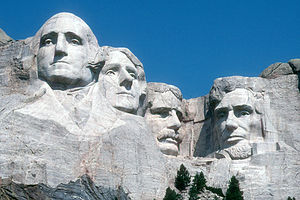
Once outside the museum, we strolled along the Avenue of Flags towards the 60-foot-high faces of George Washington, Thomas Jefferson, Theodore Roosevelt, and Abraham Lincoln set against the South Dakota Black Hills. I had seen Mt. Rushmore in pictures many times, but only in person can you realize its true grandeur and massiveness.
We took a short nature trail to the Borglum's Sculptor's Studio where we saw some of the original tools and the actual plaster model that Borglum used as a basis for carving the mountain. A guide explained to us how Borglum used a pointing system and multiplied every dimension of the model by 12 to arrive at the dimensions of the actual carving. Sounds simple, doesn't it?
For a close-up view of the actual sculpture, we walked the new ½ mile Presidential Trail which took us up to the talus slope at the base of the Monument. It really is very impressive. Because of its southeasterly orientation, the afternoon lighting wasn't that great, so we decided to save our picture taking for the morning.
I would have to say that my highlight at Mt. Rushmore was the evening lighting ceremony at the amphitheater, which is held every night at 8:00 pm. It started off with a short ranger talk and a film about the 4 presidents and then moved into the dramatic and patriotic part---the flooding of sculpture with lights as we sang the National Anthem. It really was spectacular.
Back at the campground, we went in the hot tub to see if we really had a view of the lit monument and guess what, we actually did. The campground had redeemed itself.
Before heading towards the Badlands the next morning, we drove back up the steep hill to the Monument to photograph it in the morning light. It's amazing what a difference lighting can make.
Description
Mount Rushmore, located in the Black Hills of southwestern South Dakota, is considered to be one of the man-made wonders of the world---as both a work of art and as an engineering marvel.
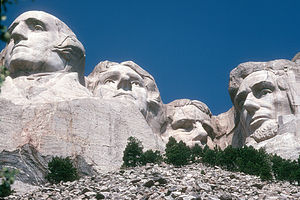 Mount RushmoreIt was created by the sculptor Gutzon Borglum, and 300 workers, who worked for more than 14 years carving the 60-foot-tall faces of four American Presidents--George Washington, Thomas Jefferson, Theodore Roosevelt, and Abraham Lincoln--out of the granite of the Black Hills mountains. It was to symbolize the spirit of our nation through four of its most revered leaders.
A short nature trail takes you to the Borglum's Sculptor's Studio, which has on display the original tools and the actual plaster model that Borglum used as a basis for carving the mountain. A 15-minute Studio Talk explains how he used this model's measurements and a pointing system (everything dimension multiplied by 12) to plan the actual carving on the mountain.
The new ½-mile-long Presidential Trail takes you from the main viewing terrace to the talus slope at the base of the sculpture. This trail provides the closest access to the sculpture.
Every evening at 8:00 pm during the summer, there is a ranger program that ends in the dramatic lighting of the memorial. The program consists of a short ranger talk, a film about the 4 presidents, the playing of the National Anthem, and the lighting of the sculpture.
Wind Cave National Park
Sunday, July 30, 2000 - 4:00am by Lolo145 miles and 3.5 hours from our last stop
Travelogue
I had made our reservations for the Candlelight Cave Tour at Wind Cave on the National Park Service website three months prior to our trip. I admit that in our early RV days, I was not much of a free spirit. In my fear of missing out on something we wanted to do or somewhere we wanted to stay, I made reservations like crazy. While this does have the benefit of ensuring that we get to do what we had planned, the downside is that we had to stick very closely to our itinerary because we were required to be in certain places at certain times. It's a definite tradeoff that we're still trying to work out.
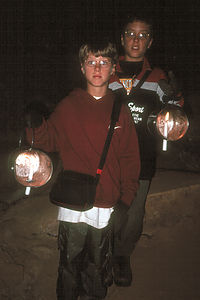 Boy's on Candlelight Cave TourWe went to the Visitor Center at the required time to meet with the ranger and the 6 other people that were to join us on our tour. One of the reasons I picked this tour was that it was restricted to 10 people, which made it nice and intimate. The ranger then gave each of us a bucket with a candle in it and lectured us on the various do's and don't of candle lantern etiquette, so that we wouldn't get hot wax on us. Ready for our tour to begin, the ranger took us on an elevator down to an undeveloped and unlit part of the cave system, so that we could experience the cave the way the early visitors did in the late 1800s---another reason I chose this tour.
We spent the next 2 hours exploring the very unique Wind Cave, which because of its relative dryness, doesn't have the usual stalactites and stalagmites that you find in most other caves in the U.S. Instead, it has these very delicate looking formations called boxwork that look like honeycombs.
Our ranger was extremely enthusiastic and absolutely enamored with caves. He told us that he had first come to Wind Cave when he was about Tommy's age and had decided then that when he grew up he would be a ranger here. What a great thing to know what you want to do in life so early and actually have it realized. I wish I knew what I want to be when I grow up.
Description
Wind Cave National Park is located in the southwestern corner of South Dakota within an hour's drive from Mount Rushmore. It is the 3rd largest cave system in the United States and contains more than 81 miles of mapped passageways. It is estimated that the mapped portion only accounts for 5% of the size of the total cave.
Wind Cave is very different than other cave systems in that it is very dry and therefore contains very few stalactites and stalagmites. Instead, it has the world's best collection of boxwork, which is an unusual mineral formation resembling irregular honeycombs. The park got its name from the incredibly strong winds that rush in and out of its entrance.
Although most people come to this park to see the caves, the more than 28,000 acres of ponderosa pine forests and rolling prairies above are worth a visit. Along the scenic drive, there is much wildlife to see, including bison, elk, pronghorn antelope, mule deer, and prairie dogs.
The park offers five different cave tours ranging from the relatively easy 1-hour Garden of Eden Tour to the 4-hour Cave Tour where you do some real caving off the established trails. The 2-hour Candlelight Tour is the most popular in that it lets you experience the cave as the first explorers of it did. Reservations for this tour should be made well in advance.
Devils Tower National Monument
Saturday, July 29, 2000 - 10:00am by Lolo312 miles and 6.5 hours from our last stop - 1 night stay
Travelogue
For some reason, Tommy had been asking how many more days until Devil's Tower ever since we left Michigan almost 2 weeks ago. I guess the thought of seeing the place where aliens landed in Close Encounters of the Third Kind was kind of intriguing to him.
 Early AM Lolo with Devils TowerIt really is a strange place, located in the middle of nowhere. We were probably more than 10 miles away from the park when we got our first glimpse of the Tower, rising dramatically up from an otherwise totally flat prairie. That's what makes it so unusual--it seems to come out of nowhere. Geologists think that the Tower is actually the core of a volcano that has eroded away.
We had chosen to stay in the KOA outside the park because we could make reservations there, so we took a quick dip to cool off in the pool and headed right over to see Devils Tower close up. There's not a whole lot to do here, so you can easily see everything in just a day. We hiked the 1.3 mile Tower Trail which goes around the entire base, getting different perspectives and photographs along the way. We had to climb up the talus slope that surrounds the base in order to get closer to the Tower. Since, the lighting wasn't that good, we decided that we would do more photography early the next morning.
As a former fanatical rock climber, Herb looked at the Tower in a very different way than we did, scanning the rock face for the hand and footholds that would determine a route to the top. That is the way he would have liked to experience Devils Tower--hopefully, some day he will. For now, climbing Devils Tower is still allowed, but the Native Americans are trying to stop what they consider to be a violation of something sacred to them.
Herb and I rose early the next morning to photograph the Tower at sunrise. The kids looked too peaceful to disturb, so we grabbed their cameras as well and ran down to the field in the campground where there was a clear view of the Tower. The lighting was terrific, so good, in fact, that before leaving the area, we drove back into the park to the Tower Trail to retake some pictures from yesterday. The good lighting was going fast, so Herb, laden with all types of photographic equipment hanging around his neck, jogged around the base by himself taking more pictures of the Tower in the morning light.
We said goodbye to the Tower and headed on to South Dakota.
Description
Devils Tower National Monument is located in extreme northeast Wyoming. Despite the fact that it is way off the beaten path, it still receives more than 450,000 visitors annually, who come here to hike, climb, or just look at the incredible 865-foot-high monolith. It is probably best known as the place where alien spaceships landed in the movie Close Encounters of the Third Kind. In 1906, President Teddy Roosevelt designated the Tower and the 1,347 acres surrounding it as our nation's first National Monument.
 Devils TowerGeologists believe that Devils Tower is actually the igneous core of a volcano that has been exposed as a result of millions of years of erosion. The vertical columns were formed by the cracking and fracturing of the molten rock as it cooled. Most of these columns are polygonal (5-sided) and measure 6 to 8 feet in diameter at the base and taper to 4 feet in diameter at the summit. Much of the original formation that has peeled and crumbled off has created a boulder field all around the Tower.
The Native Americans have a different version as to how Devils Tower was formed. According to their legend, seven sisters ran away from their brother who was turned into a bear. A large tree stump beckoned them to climb on. When they did, the stump rose into the sky as the brother scratched it with his claws. Native Americans feel that the Tower, which they call Mateo Tepee or Grizzly Bear Lodge, is sacred to their religion. They have asked the National Park Service to not allow people to climb it so that they can conduct their religious ceremonies.
The Tower was first climbed on July 4, 1893, by William Rogers and Willard Ripley. They used a wooden ladder for the first 350 feet of the climb. 1,000 people watched as they made their hour long climb to the summit where they raised an American flag. Two years later, Mrs. Roger's became the first woman to climb the Tower. She used her husband's ladder. By 1997 more than 5,000 people had climbed the Tower. Today, climbers must register with the ranger before they begin their climb and again when they return.
For those not inclined to climb Devils Tower, a good way to experience it is the 1.3 mile Tower Trail with goes around the base of the Tower, offering close-up views along the way.
There is a 55-site campground in the park along the Belle Fourche River that works on a first-come, first-serve basis.
Grand Teton National Park
Friday, July 28, 2000 - 3:00am by Lolo60 miles and 1.5 hours from our last stop
Travelogue
This was actually our second time to the Grand Tetons. The first time was back in 1992, when we just drove through the park on our way to Yellowstone, enjoying the tremendous views of the Jackson Hole Valley and mountain peaks along the Teton Park Road, but hardly doing the park the justice it deserved. This time, our plan was much better--to experience the park from our inflatable raft while floating down the Snake River through the Jackson Hole Valley.
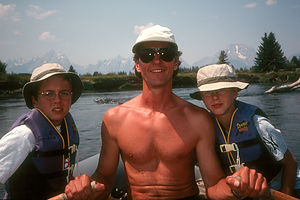 Herb and the boys rafting the Snake RiverRafting trips are always a logistical nightmare because you have to leave your vehicle in one place and then float downstream about 10 miles only to have to figure out how the heck to get back to your RV at the end of the day. However, rafting this river was something we wanted to do so badly that we figured we'd raft first and worry about the logistics later.
We put the raft in at the Moran Junction raft launch right off US 191 south of the Jackson Lake Dam. The water along this stretch of the Snake River was pretty gentle (Class I and Class II rapids), but quick moving and very braided, which meant that there were many islands where you had to quickly make a choice as to which side to go on. The wrong choice could bring you to a dead end in the river with no easy way to get back to the right choice. We thought that we would just follow other rafts that had guides, but surprisingly, and quite pleasantly, there was no one else out on the river, so we, or more correctly Herb, had to read the way the water was flowing to try to pick the main channel. He did great. The scenery along the way was absolutely incredible, with views of the Jackson Hole Valley and the snow-capped Teton Range to the west of us.
 Tom with tiny fishThe river was moving so fast that our 10-mile trip was going to be over in no time at all. We were having too good of a time for it to end so soon, so we kept pulling up onto beaches to explore and fish. "Nature Tom" had his Animal Tracking field guide along so the kids spent some time wandering up and down the river trying to identify the numerous tracks along the shore. At one point along the river's edge, we came across some wet sand that acted like quicksand, sucking our sandaled feet below the surface. It was quite a struggle to get them out. In fact, Andrew's sandal was pulled right off his foot and we had to quickly reach down with our hands to pull it out before it disappeared completely. I don't think we were going to actually get sucked down too far, but it still was rather disconcerting.
Some friendly little family fishing soon turned into a fierce competition to see who could catch the most trout. Tommy was winning with two, when I decided to put down my book and give it a try. In three casts, I caught 3 trout--1 rainbow, 1 brown, and 1 cutthroat. The third one came off my line right before I pulled it on shore, triggering a heated debate from Tommy as to what the criteria was for considering a fish caught. To this day, we still haven't resolved this issue.
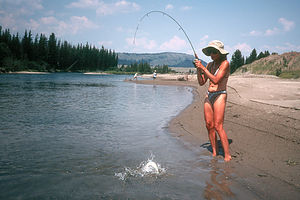 Lolo hauling in a big oneAs the afternoon wore on, thunderclouds started building over the valley, so we got back in the raft and let the swift current of the river carry us to our takeout at the Snake River Overlook. We still had to figure out how to get the RV. Herb decided to walk up to the highway and hitchhike back to Moran Junction. He wasn't having much luck at all on the highway--after a day on the river he was looking a bit grungy. Finally, he got the idea of going to the Overlook parking lot where he could approach people and convince them that he was not a threat. A family accepted his offer of $10 to drive him the 10 miles back to Moran Junction, which is where they were going anyway. Herb even gave them a tour of the RV.
While all this was going on, the kids and I were deflating and cleaning the raft, hoping the thunderstorm would miss us, which it fortunately did. It seemed like Herb was gone an awfully long time so were very relieved when we saw the RV pull down the hill to pick us up.
We packed the raft back into the bag that lived on top of the cab at the foot of the kids' bed. Our little "boat in a bag" had done it again. For the third time this trip (first Pictured Rocks, then St. Mary's Lake in Glacier, and now the Snake River), it had given us the kind of day that no amount of money could buy.
Somewhat tired, but very satisfied, we left the Grand Tetons to find a place to stay for the night.
Description
Grand Tetons National Park's 485 square miles encompasses the Jackson Hole Valley and the Teton Mountain Range which towers 7,000 feet above the valley floor. Although the park is best known for its three most prominent peaks, the Grand, Middle, and South Tetons, there are other equally spectacular mountains in the Teton Range, 12 of which are higher than 12,000 feet.
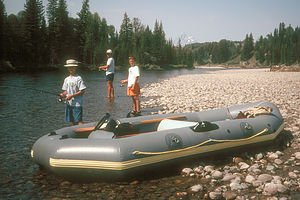 Herb and boys fishing for trout on the Snake River At the base of the mountains lies a string of 7 glacier-carved lakes, fed by mountain streams. Beyond the lakes lies the beautiful Jackson Hole Valley with 50 miles of the Snake River winding through it. The wetlands along the braided sections of the river provide a rich habitat for wildlife, such as moose, elk, pronghorn, bison, black bear, deer, bald eagles, blue herons, river otters, and even pelicans.
Most of the major observation points and attractions can be seen from the Teton Park and Jenny Lake Loop Roads, which meander 25 miles along the Jackson Hole Valley from Moran Junction to Moose Junction, providing spectacular views of the Tetons along the way.
The 4-mile paved Signal Mountain Summit Road climbs 1,000 feet to the summit of Signal Mountain, where there is a tremendous 360 degree panoramic view of the Tetons and Valley below. A mile before the summit is the Jackson Lake Overlook, from which William Henry Jackson took his famous photographs of the Grand Tetons. Unfortunately, the Signal Mountain Summit Road is so narrow and windy that RV's are prohibited.
The one-way scenic drive on the Jenny Lake road along the shores of the lake brings you to one of the busiest and most popular sports in the park. A very popular hike from this area is the Cascade Canyon Trail to Hidden Falls and Inspiration Point. To get to the trailhead you can either walk the 2.5 miles around the southern end of the lake or take the shuttle boat, which runs every ½ hour, across to the West Shore Boat Dock. From there, the fairly strenuous trail climbs 420 feet over one mile. At the ½ mile point is Hidden Falls, one of the most beautiful spots in the park. A ½ mile further is the aptly named Inspiration Point with a spectacular view of the lake, surrounding mountains, and the valley. If you wish to continue further, the trail levels out after this point and the views get even better. On the way back, you have the same choice of hiking the lakeshore or taking the shuttle boat.
